
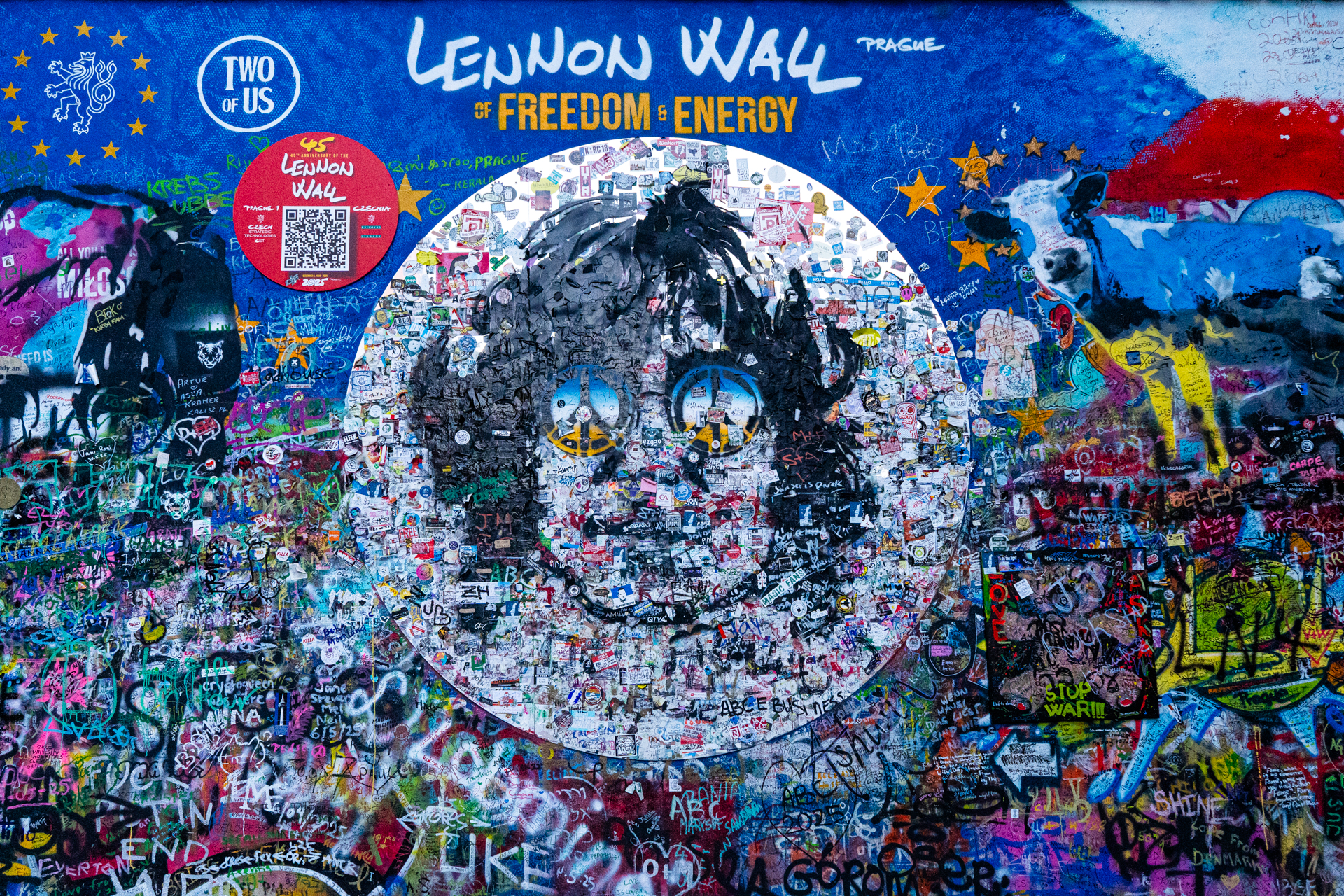
One of the places I visited while in Prague in 2025 was the Lennon Wall. It’s far more than just a colorful graffiti-covered surface. It is a living, ever-changing canvas that reflects decades of political resistance, artistic freedom, and human expression. Located in the charming district of Malá Strana, this iconic wall has evolved from a simple structure into one of the most meaningful cultural landmarks in Europe.
The primary function of the Lennon Wall has never been official or institutional, it emerged organically as a space for free expression. Over time, it became a public platform where people could share messages of peace, love, hope, and political dissent. Especially during the communist era in Czechoslovakia, the wall served as a rare outlet for citizens to voice their frustrations and dreams in a society where freedom of speech was heavily restricted. Messages painted on the wall often included song lyrics inspired by John Lennon and The Beatles, alongside slogans advocating human rights and equality1. Today, the wall continues to function as an open-air gallery where visitors from around the world contribute their own artwork and messages. Although certain regulations now limit the use of spray paint, the spirit of participation remains alive, making the wall a constantly evolving piece of collective creativity2.
The history of the Lennon Wall dates back to the late 1960s, when political slogans first began appearing during the period of unrest following the Soviet invasion of Czechoslovakia. However, the wall gained its iconic identity after the death of John Lennon in 1980. Shortly afterward, a portrait of Lennon was painted on the wall, turning it into a symbolic memorial3. During the 1980s, the wall became a focal point for anti-communist sentiment. Young people used it to express dissatisfaction with the regime, often repainting messages that authorities repeatedly tried to erase. This ongoing “battle” between citizens and the government transformed the wall into a powerful symbol of resistance. In 1988, tensions even escalated into clashes between students and police, highlighting the wall’s political significance4. After the fall of communism, the wall’s role shifted from protest to global symbol. It now represents universal values such as peace, creativity, and freedom, attracting millions of visitors each year.
The Lennon Wall is located at Velkopřevorské náměstí in Malá Strana, just a short walk from the famous Charles Bridge. It sits near the French Embassy and is surrounded by picturesque streets, historic buildings, and the scenic Vltava River5. Despite being close to major tourist attractions, the wall is tucked away in a relatively quite and intimate square, giving it a unique atmosphere compared to Prague’s more crowded landmarks. The surrounding area includes charming cafés, small galleries, and nearby attractions such as Kampa Island, making it an ideal stop during a walking tour of the city. If you want to visit here, you can use the map below:
Reaching the Lennon Wall is quite easy due to its central location. The simplest way is by walking (after crossing Charles Bridge) toward Malá Strana, it takes only about five minutes to reach the wall by following signs to Velkopřevorské Square. For those using public transportation, several tram lines (such as 12, 15, 20, and 22) stop at Malostranské náměstí, from where the wall is just a short walk away. Alternatively, visitors can take the metro Line A to Malostranská station and continue on foot for around 10–15 minutes6. Although it is possible to reach the area by car, parking can be challenging due to the narrow streets and limited space in central Prague.
One of the most fascinating aspects of the Lennon Wall is that it is never the same twice. Layers of graffiti are constantly painted over, creating a dynamic artwork that evolves daily. This makes every visit a unique experience7. Additionally, the wall is owned by the Knights of Malta, yet it has long been tolerated as a public space for artistic expression. This unusual combination of private ownership and public participation adds to its uniqueness8. While many people associate the wall solely with John Lennon, it actually represents a broader cultural movement. Lennon himself never visited Prague, but his ideals of peace and freedom resonated deeply with people living under an oppressive regime.
The Lennon Wall in Prague is more than just a tourist attraction. It is a powerful reminder of the human desire for freedom and self-expression. From its origins as a site of political resistance to its current role as a global symbol of peace and creativity, the wall continues to inspire visitors from all walks of life. Whether you come to admire the artwork, leave your own message, or simply reflect on its history, the Lennon Wall offers a deeply meaningful experience that captures the spirit of Prague itself.
- https://prague.org/discover-the-significant-of-the-john-lenon-wall/ ↩︎
- https://www.storyhunt.io/en/articles/john-lennon-wall ↩︎
- https://www.avantgarde-prague.com/lennon-wall ↩︎
- https://prague-stay.com/lifestyle/review/57-sights-in-prague/62-lesser-town-sights-prague-sightseeing/222-lennon-wall ↩︎
- https://prague.org/discover-the-significant-of-the-john-lenon-wall/ ↩︎
- https://prague.org/discover-the-significant-of-the-john-lenon-wall/ ↩︎
- https://prague-stay.com/lifestyle/review/57-sights-in-prague/62-lesser-town-sights-prague-sightseeing/222-lennon-wall ↩︎
- https://prague.org/discover-the-significant-of-the-john-lenon-wall/ ↩︎


Leave a Reply