
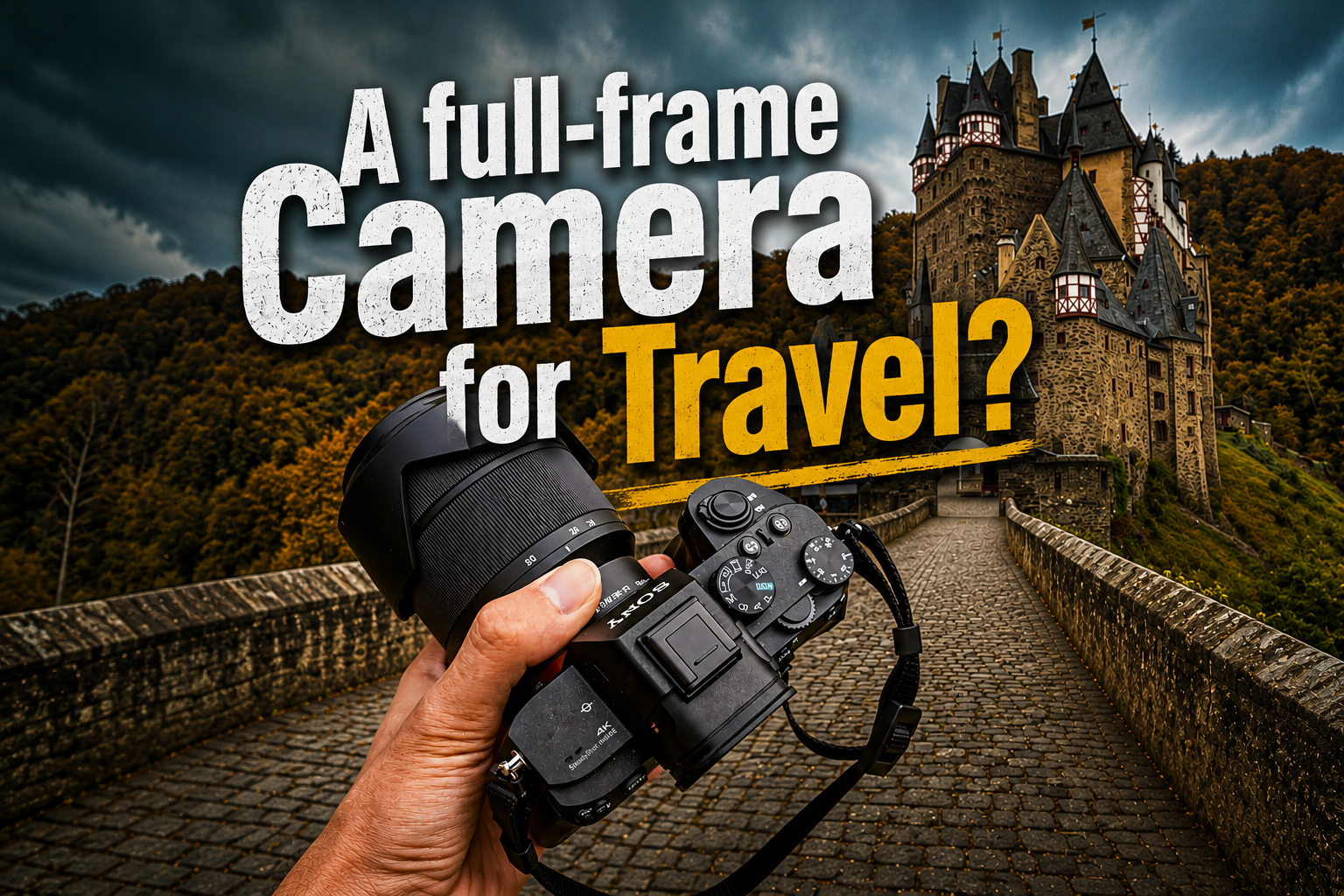
Whenever I travel, I pack my luggage as efficiently as possible. Many of the items I bring are travel-sized versions (smaller and more compact). After all, I essentially travel as a backpacker; everything I need must fit into the single backpack I carry, including my photography gear.
I used an APS-C camera for my travels for quite a long time before I finally began considering purchasing a full-frame camera. My old APS-C camera was a Sony a6000. At that point, I felt that my camera had reached its absolute limits, yet I still craved even better image quality.
Before deciding on a purchase, I spent a great deal of time weighing my options to see which cameras might be the right fit. I began to take a keen interest in the Nikon Z f and the Nikon Z 5 or Z 6. Prior to owning a Sony, my very first camera had been a Nikon, so I was already quite familiar with Nikon’s camera ecosystem. I held the belief that Nikon cameras were excellent, particularly for landscape photography. This aligned perfectly with my personal habits, as I tend to prefer photographing landscapes and inanimate objects rather than shooting portraits. Unfortunately, at the time, I didn’t have sufficient funds to make the purchase. Furthermore, after doing some additional research, it appeared that those specific cameras might not be the best match for my needs; I required a camera that offered greater versatility.
I also found myself drawn to Leica. With its elegant M-Series, the brand held a certain allure for me. I spent a considerable amount of time contemplating the idea. It might seem a bit amusing, given that I couldn’t even afford a Nikon at the time, to wonder how I could possibly afford a Leica. The answer was simple: I could either buy a pre-owned unit or save up the money first. However, after much deliberation, I came to the conclusion that a Leica M camera wouldn’t be a good fit for me after all. Since I tend to be somewhat “careless” by nature, often venturing into whatever terrain strikes my fancy, carrying a Leica would inevitably leave me constantly plagued by the fear that the camera might get scratched or even damaged.
This sense of indecision continued to swirl in my mind. I found myself asking: Is it truly necessary for me to buy a full-frame camera for my travels?
Full-frame cameras are notorious for being heavier and bulkier than their counterparts. I worried that this added weight and size might prove to be a hindrance during my travels. However, aren’t there full-frame cameras that are quite manageable in terms of size and weight. Like the Sony A7C. At the time, I was rather naive; I wanted to experience what it felt like to use a camera that “looked” professional. Had I chosen the A7C, I wouldn’t have got that specific sensation. Even though that camera is widely used by professionals as well. But, for whatever reason, I simply craved a more substantial feel.
Because of those concerns regarding size and weight, I began considering a premium APS-C camera that I could potentially own. Such as the Ricoh GR III, Nikon Zfc, or the Fujifilm X100 series. These cameras were certainly intriguing, but ultimately, they didn’t quite meet my expectations. I wanted a mirrorless camera that felt more professional, could withstand any environment, was reasonably affordable, and could be utilized for a wide variety of genres.
Finally, my choice landed on the Sony A7 III. This wasn’t a new model; in fact, by that time, the latest version of the A7 series had already been released. Furthermore, there were other versions specifically tailored for still photography, such as the A7R III. However, I felt I needed a camera that offered flexibility. One capable of handling not just photography, but videography as well. That is precisely why I felt the A7 III was the perfect fit for me.
My first impression was that it finally satisfied my craving for photo quality superior to that of my previous camera. Of course, I also noticed the increased weight. In the beginning, my hands would actually ache quite a bit after a photo-hunting session. However, I felt that was to be expected.
After using this camera for over a year, I’ve come to realize that its weight and dimensions aren’t actually a major issue. I’ve taken it along on my travels, not only within Germany but also to Morocco, the Netherlands, and Belgium. I fully intend to bring it along to every other country I visit in the future.
After using the kit lens for quite some time, I finally decided to purchase a lens of higher quality: the Sony FE 24-50mm f/2.5 G. This lens is relatively lightweight compared to the GM series lens I had originally coveted. For the time being, I am extremely satisfied with it; it complements my travel photography perfectly. It isn’t overly heavy, yet it delivers superior quality.
Although I personally feel that bringing a full-frame camera along while travelling is an excellent choice, ultimately, this remains my own subjective opinion. If you are considering purchasing a similar camera system, I suggest asking yourself: what is it that you truly want and need? For me, it poses no issue, as my approach to travelling is extremely laid-back; I simply wander around, taking in the interesting sights and experiences a place has to offer. A full-frame camera might not be the right fit for those of you who maintain a highly active pace while travelling, especially if you engage in activities that are particularly extreme.


Leave a Reply